
Release time:13 10 月, 2026
Large-scale cattle ranches and swine farms generate massive volumes of high-moisture slurry and solid manure daily. Untreated livestock waste poses severe environmental risks, including groundwater contamination, heavy odor, and regulatory penalties. However, with an advanced livestock manure fertilizer production line, raw cattle dung and pig waste can be transformed into high-grade organic fertilizer pellets, unlocking a lucrative new revenue stream.
Investing in a complete livestock waste processing plant allows agricultural enterprises to convert environmental compliance costs into sustainable commercial profits.
Converting high-moisture livestock waste into dense, marketable organic fertilizer pellets requires a specialized, multi-stage processing technology:
Raw cattle slurry or flushed pig manure typically contains over $80\%–90\%$ moisture. Our heavy-duty stainless steel screw press separators dewater the raw manure first, reducing moisture content down to $60\%$, making it ideal for aerobic composting while discharging clarified liquid for biogas or fertigation.
Dewatered solid manure passes through automated compost turners or vertical aerobic fermentation tanks. Thermophilic microbial activity raises temperatures to $60^\circ\text{C}–70^\circ\text{C}$, rapidly killing weed seeds, pathogens (like E. coli), and fly larvae while reducing moisture below $30\%$.
Composted organic mass is crushed using a semi-wet material crusher to eliminate caked lumps. Automated micro-dosing systems blend the organic powder with humic acid, trace elements, or beneficial bio-inoculants based on target agronomic formulas.
The conditioned powder is fed into an Organic Fertilizer Granulator (such as a New Type Agitation Granulator or Double Roller Extruder) to form smooth, uniform spherical pellets. A rotary drum dryer and counterflow cooler stabilize moisture below $15\%$ and ensure long storage stability before automated bagging.
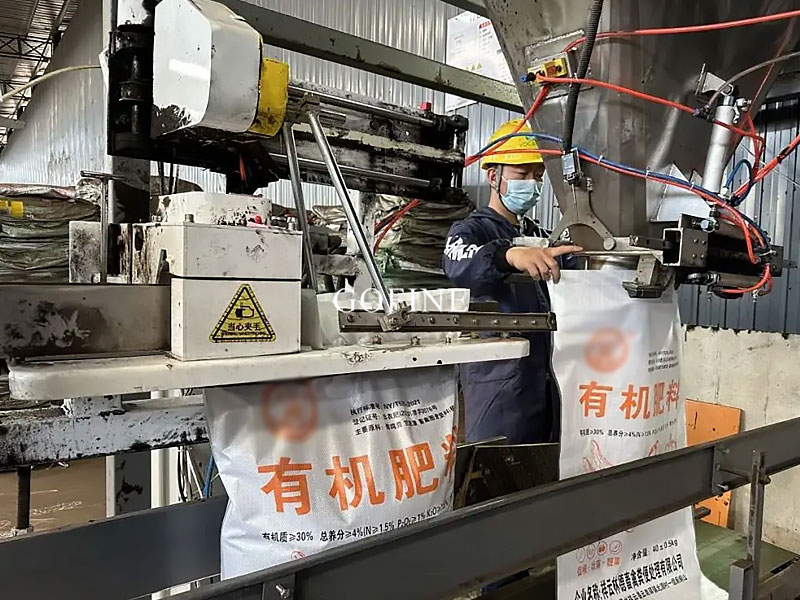
We configure scalable livestock waste fertilizer equipment to handle various farm production scales:
| Plant Capacity | De-watering Equipment | Primary Granulator Model | Total Power (kW) | Recommended Farm Size |
| 1 – 2 Tons/Hour | Single Screw Press Separator | Disc / Pan Granulator | 85 – 120 kW | 500-1,000 Dairy Cows / 3,000 Pigs |
| 3 – 5 Tons/Hour | Dual Screw Press System | New Type Wet Granulator | 180 – 260 kW | 2,000-5,000 Dairy Cows / 10,000 Pigs |
| 5 – 10 Tons/Hour | Heavy Duty Slope Screen Separator | Rotary Drum Granulator | 350 – 520 kW | Regional livestock waste processing hubs |
| 10+ Tons/Hour | Fully Automated Complex | Double Roller Extruder Group | Customized | Large-scale agricultural integration projects |
High-Moisture Handling Expertise: Our specialized screw press separators and agitator blades prevent clogging when handling fibrous cattle dung or sticky pig manure.
Heavy Corrosion Protection: Machine parts contacting wet manure are fabricated with SUS304 stainless steel or anti-corrosion manganese alloy plates for extended service life.
Automated Siemens PLC System: Centralized touchscreens monitor batching precision, motor loads, and moisture metrics with minimal manual labor.
Complete EPC Delivery: We provide end-to-end services including 3D plant CAD design, steel structure fabrication, on-site commissioning, and global technical support.
A: Raw cattle dung contains extremely high water content ($85\%+$). Composting requires an ideal moisture level of $50\%–60\%$. Dewatering via a screw press separator reduces moisture efficiently without requiring excessive dry bulking agents.
A: Yes. Our crushers and granulators are engineered to process mixed formulas containing cattle dung, pig waste, horse manure, and agricultural straws simultaneously.
Ready to turn your farm waste into high-value organic fertilizer? Contact our process engineering specialists today for a custom CAD layout, flow chart, and direct factory quote!
 Hi, this is YAN, Want details & price?
