
Release time:10 10 月, 2026
With global environmental regulations tightening and the demand for sustainable agriculture soaring, livestock farms face immense pressure to manage poultry waste efficiently. Raw chicken and turkey manure, if left untreated, cause severe groundwater pollution and odor issues. However, when processed with an advanced poultry manure organic fertilizer production line, this waste converts into high-value, nutrient-rich organic fertilizer pellets.
Investing in a turnkey fertilizer manufacturing plant allows poultry farm owners and commercial fertilizer producers to reduce environmental compliance costs while opening lucrative new revenue streams.
Converting wet poultry droppings into bio-organic fertilizer pellets requires a systematic, multi-stage technological workflow designed to eliminate pathogens and optimize nutrient ratios.
Raw poultry manure typically contains $60\%–70\%$ moisture along with harmful pathogens, weed seeds, and insect eggs. Our automated composting turners or vertical fermentation tanks utilize aerobic thermophilic bacteria to elevate temperatures to $55^\circ\text{C}–65^\circ\text{C}$, rapidly deodorizing the material and reducing moisture content below $30\%$.
Once fully composted, the organic material passes through a high-moisture semi-wet material crusher. This machine breaks down caked manure blocks into uniform fine powders. Automated batching systems can then add micro-nutrients (N-P-K), humic acid, or beneficial bio-bacteria according to your target fertilizer formula.
The mixed powder is fed into a specialized organic fertilizer granulator (such as a New Type Organic Fertilizer Granulator or Disc Granulator). Using mechanical agitation, the powders sphericalize into smooth, dense granules with high compression strength.
A rotary drum dryer reduces granule moisture below $15\%$, followed by a counterflow cooler to stabilize granule temperature. Finally, a rotary screening machine separates off-spec particles, and an automated bagging scale packages the commercial fertilizer into 25kg, 50kg, or jumbo bags.
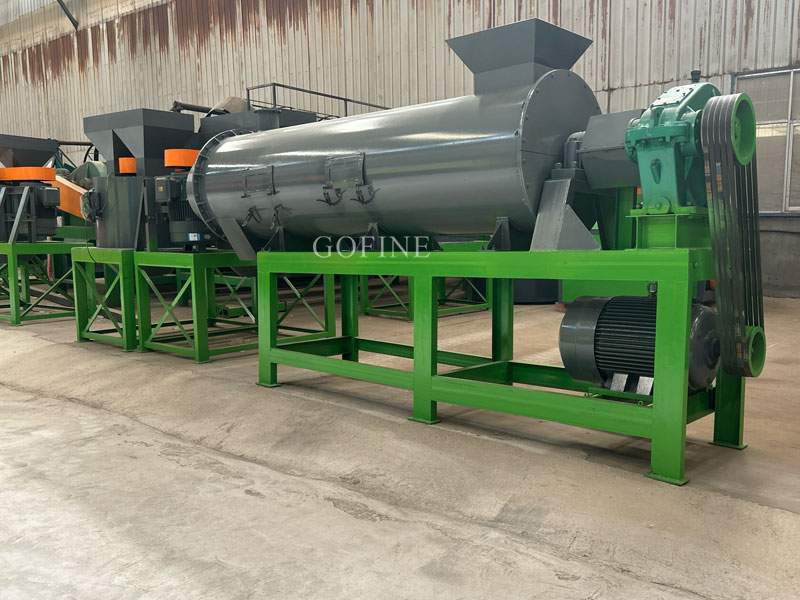
We configure scalable organic fertilizer production equipment to suit various farming scales:
| Plant Capacity | Primary Fermentation Type | Granulator Model | Total Power (kW) | Target Application |
| 1 – 2 Tons/Hour | Compost Turner / Windrow | Disc / Pan Granulator | 75 – 110 kW | Small-to-medium poultry farms (100k-200k birds) |
| 3 – 5 Tons/Hour | Groove Turner / Vessel | New Type Wet Granulator | 160 – 240 kW | Commercial organic fertilizer producers |
| 5 – 10 Tons/Hour | Vertical Fermentation Tank | Double-Roller Extruder | 320 – 480 kW | Regional waste management centers |
| 10+ Tons/Hour | Fully Automated Complex | Rotary Drum Granulator | Customized | Large-scale agricultural integration projects |
High Bio-Nutrient Retention: Our low-temperature drying and controlled fermentation tech prevent nitrogen loss, preserving organic carbon and active microbial matter.
Corrosion-Resistant Engineering: Machinery components contacting raw manure are constructed from SUS304 stainless steel or heavy-gauge anti-corrosion alloy plates to ensure long service life.
PLC Smart Automation: The entire line is monitored via a central Siemens PLC touchscreen system, reducing labor costs by up to 60%.
Full EPC Turnkey Delivery: From initial 3D plant layout design and civil engineering guidance to equipment manufacturing, installation, and operator training.
A: The ideal moisture content for aerobic composting is $50\%–60\%$. For wet granulation (using our new type organic fertilizer granulator), the composted powder moisture should be maintained around $25\%–35\%$.
A: Traditional windrow composting takes 15–20 days. When using our sealed vertical aerobic fermentation tanks, the cycle is dramatically reduced to just 7 to 10 days with zero odor emissions.
Planning to turn your poultry manure into profit? Contact our fertilizer process engineers today to receive a customized CAD layout, flow chart, and factory-direct quotation.
 Hi, this is YAN, Want details & price?
